
If walking into a gym makes your stomach tighten, you have plenty of company, and the feeling isn't a character flaw. In a 2025 survey by fitness app Flex Fitness, more than 40% of Americans said apprehension about the gym keeps them from working out. Nearly half said they feel watched or criticized once they're inside.
For adults over 40, that feeling tends to stick around. The useful move isn't talking yourself out of it. It's choosing a place where the things you're nervous about have already been handled.
Below is what the research says about why the feeling lasts, why confidence decides who keeps training, and what a well-designed environment does for you before you lift anything.
Gym intimidation doesn't fade on its own
Most advice treats gym nerves as a beginner phase. The data says otherwise. In the same Flex Fitness survey, more than half of people ages 45 to 60 said they had carried that self-consciousness for more than five years. More than half of women said the same.
Five years is a long time to wait for a feeling to pass. If it hasn't faded by now, more time on the sidelines probably won't change it. A different setting might.
The survey also found that being judged on looks or fitness level was the biggest fear. That detail matters, because it points at the room, not at you. Most people aren't afraid of exercise. They're uneasy about exercising in front of strangers who seem to know exactly what they're doing.
Confidence predicts who keeps going
Confidence isn't a soft extra. Researchers call it self-efficacy: how much you believe you can do the exercise in front of you. In a study of formerly sedentary middle-aged adults, self-efficacy significantly predicted who was still exercising at follow-up.
A later six-month trial followed 174 formerly sedentary older adults with an average age of 65.5. Three things directly built their exercise confidence: doing the activity, feeling good during it, and having social support around it.
Willpower isn't on that list. Confidence grew out of experience and out of the people in the room. That means you can build it on purpose by picking an environment that supplies those inputs.
The default gym path tends to skip them. One study followed 184 new, previously untrained fitness-club members in Norway for a year. The group averaged 37.5 years old, so it describes new gym members in general rather than adults over 40 specifically. At 12 months, 57.2% were still exercising regularly and 28.3% had dropped out entirely. Only 37% stayed regular the whole year. A key fob and a locker aren't much of a start.
The four fears, and what answers each one
Most gym nerves come down to four specific worries. Each one has a practical answer, and none of them requires you to become a different person first.
Being judged
This is the fear from the survey: feeling watched and sized up on how you look or how fit you are. Big open gym floors make it worse. Everyone can see everyone, and nobody's job is to make you comfortable.
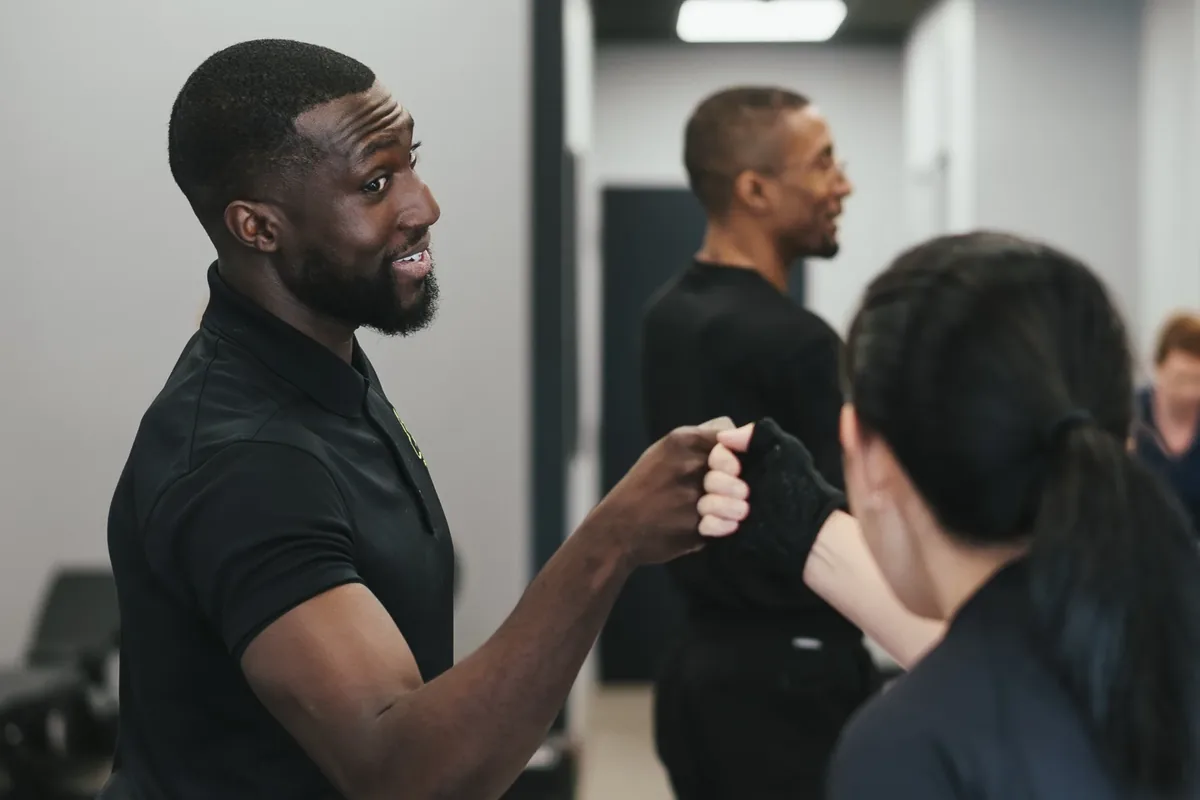
The answer is a smaller room. When a session holds a handful of people, each working through their own program with a coach, there's no audience. Everyone is busy with their own next set.
Not knowing what to do
The CDC lists lack of skill among the common personal barriers to physical activity. Standing in front of an unfamiliar machine, trying to look like you have a plan, wears people down fast.
Nobody should have to earn their way into coaching. Someone who knows what they're doing hands you the plan and teaches it. You shouldn't have to research your way into your first workout.
Getting hurt
The CDC also names fear of injury as a common barrier. Its guidance is to learn a proper warm-up and cool-down, choose activities you can do safely, and progress gradually as your confidence grows. The worry shows up in other research too: a 2021 scoping review of 34 studies identified fear of injury among nine fear-related barriers to activity in adults with overweight and obesity.
That fear is reasonable after 40, especially if you carry an old knee or shoulder story. Supervision helps. A systematic review of nine studies in older people found adherence rates were generally higher in supervised exercise programs. A coach who watches your form and adjusts a movement when it doesn't look right takes most of the guesswork off your plate.
Being the oldest person in the room
People rarely say this one out loud, but the survey hints at it: the 45 to 60 group carried gym self-consciousness the longest. Walking into a room full of 23-year-olds doing box jumps would make most of us hesitate.
The answer is a room built for you. In a studio that trains adults from 40 to 70 and up, you aren't the outlier. You're the typical member.

What the right environment does for you
Most advice on gym intimidation asks you to work on yourself: push through, reframe it, ignore the stares. That puts the whole job on the person who already feels uneasy. A better approach changes the setting so there's less to push through.
One study gave older adults (average age 63.8) exercise plus structured behavioral support and compared them with a group doing exercise alone. At 24 weeks, the supported group showed significantly higher adherence and higher exercise self-efficacy, with confidence scores of roughly 74 versus 53. It was a small study of 63 people, so treat it as one signal rather than settled science. It points the same direction as the rest of the research: structure and support outlast willpower.
Here's what that looks like in practice.
A capped group. Small group personal training at Alloy Personal Training Colorado Springs caps every session at six members. That's small enough for the coach to see every rep, and small enough that nobody is performing for a crowd. It also supplies the kind of social support the six-month trial linked to stronger confidence.
A coach who runs the whole session. A professional coach leads each session start to finish and progresses or modifies every exercise for each member. You're never left to figure out the next move alone. Your programming and progress are tracked over time, so the coaches know where you're starting from each day.
An assessment before workout one. This is the piece that removes two fears at once. Before your first training session, you sit down for a health history, a conversation about your goals, an InBody body composition scan (muscle mass, body fat percentage, visceral fat, hydration), and a functional movement assessment. Only then do you do an introductory workout, and you leave with a membership recommendation instead of a sales pitch.
Building the plan from your baseline handles "not knowing what to do," because you never have to guess. It handles "getting hurt," because the coach has already seen how your hips, shoulders, and knees move before choosing a single exercise. It's hard to do the wrong exercise when the plan was built from where you actually are. That's the whole idea behind the Starting Point Session. If you want to know exactly what happens when you walk in, our first-visit guide walks through it step by step.
Questions people ask
Is it normal to feel intimidated by the gym after 40? Yes. In a 2025 survey by fitness app Flex Fitness, more than half of people ages 45 to 60 said they had felt self-conscious about the gym for more than five years. It's a common reaction to a setting that wasn't built with you in mind. It says nothing about whether you're capable of training.
Do the nerves go away once you start? For many people they ease as confidence builds. Research on exercise self-efficacy found that doing the activity, enjoying it, and having support around you all raise confidence over time. Most members notice their energy, strength, and confidence improving within the first few weeks, though everyone moves at their own pace.
What if I haven't exercised in years? That's a common starting point, not a disqualifier. Begin with an assessment so your program starts at your current level, then progress gradually. The CDC recommends the same approach: choose activities you can do safely and build up as your confidence grows.
Do I need to get in shape before joining a small group? No. In a coached small group, every exercise is progressed or modified for the person doing it, so members at very different levels can train in the same session. Your plan starts from your baseline, not anyone else's.
Walk in knowing the plan is already yours
The Starting Point Session takes the guesswork out of day one: your history, your goals, a movement assessment, then an introductory workout built from what your coach learned. You'll find us on Woodmen Road in north Colorado Springs.