
In Colorado, as in every other US state, anyone can legally call themselves a personal trainer tomorrow. No state requires a government-issued license to do the job. That means the vetting is on you.
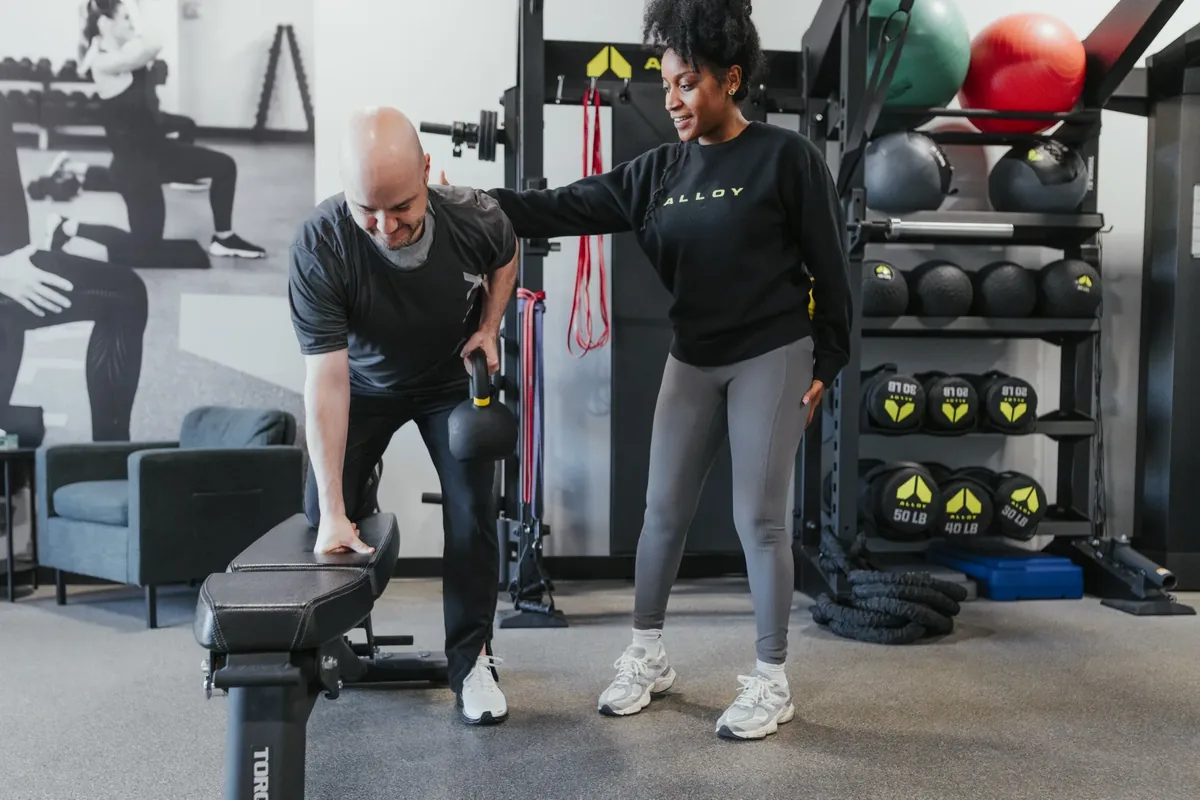
The good news is that vetting a trainer isn't hard once you know what to check. Look at four things: the credential behind their title, how they start with a new client, how they build your program, and how they keep you showing up. Each one has questions with answers you can verify.
If you're over 40, this matters more. You likely bring an old injury, a busy schedule, or a few years away from training. A good trainer plans around all of that from day one.
Start with credentials, because the law doesn't check them
The minimum bar is an accredited certification. NIH's MedlinePlus consumer guide tells people to look for a certification accredited by the National Commission for Certifying Agencies (NCCA). It also suggests weighing a college degree in exercise science, along with experience, personality, and schedule fit.
Past that floor, credentials vary a lot in rigor. Think of them in three tiers.
The floor: an NCCA-accredited certification
This is the floor. NCCA accreditation means an outside body has reviewed how the certifying organization builds and runs its exam. If a trainer can't name their certification, or names one you can't find as NCCA-accredited, keep looking.
The middle: exam-based personal trainer certifications
Many respected personal trainer credentials sit here. The NASM Certified Personal Trainer, for example, is NCCA-accredited and requires you to be 18 or older, hold a high school diploma or GED, and have current CPR/AED certification. It doesn't require a college degree. That's a legitimate starting credential, and plenty of excellent coaches hold one. Just know it measures what someone passed on an exam, not years of formal study.
The top: degree-required credentials
Two credentials stand out because a bachelor's degree is part of the entry ticket:
- CSCS (Certified Strength and Conditioning Specialist). Issued by the National Strength and Conditioning Association, whose certification program is NCCA-accredited. It currently requires a bachelor's degree, CPR/AED certification, and passing the exam. Targeted for 2030, candidates will need a bachelor's in a strength-and-conditioning-related field from an NSCA-approved accredited program.
- ACSM-EP (ACSM Certified Exercise Physiologist). Issued by the American College of Sports Medicine, whose certification programs operate under NCCA standards. It requires a bachelor's in exercise science or an equivalent field from a regionally accredited institution. Starting August 15, 2027, that degree must come from a CAAHEP-accredited program.
Here's a local detail most people don't know: the NSCA is headquartered right here in Colorado Springs.
As an example of what this looks like on a real roster, the coaching team at Alloy Personal Training Colorado Springs includes Sean Riden (M.S., CSCS) and Carter Goodson (MSc, ACSM-EP). Logan Brodine (MS) owns the studio with his wife Bostyn Brodine (MBA) and Dr. Brea Burger (PhD). He spent 11+ years as a Human Performance Specialist with the 10th Special Forces Group (Airborne) at Fort Carson, designing training and injury-recovery programs for operators, and later served as Tactical Program Manager for the NSCA. You can check any studio's coaching team page the same way: look for named credentials, not vague "certified" claims.
Look for an assessment before the first workout
A good trainer learns about you before handing you a program. Your first session should feel more like a conversation and a check-in than a hard workout.
A solid intake covers:
- Health history. Past injuries, surgeries, and anything that bothers you now.
- Goals in your words. Hiking without your knees complaining is a different goal from dropping two pant sizes, and the program should reflect that.
- A movement assessment. Watching you squat, hinge, push, and balance shows where to start and what to modify.
- A baseline measurement. Some studios use body composition scans so progress isn't judged by the bathroom scale alone.
If a trainer skips straight to a sweat-drenched workout on day one, they're guessing. For a picture of a structured first visit, see how a Starting Point Session works.
Ask how the program is built and progressed
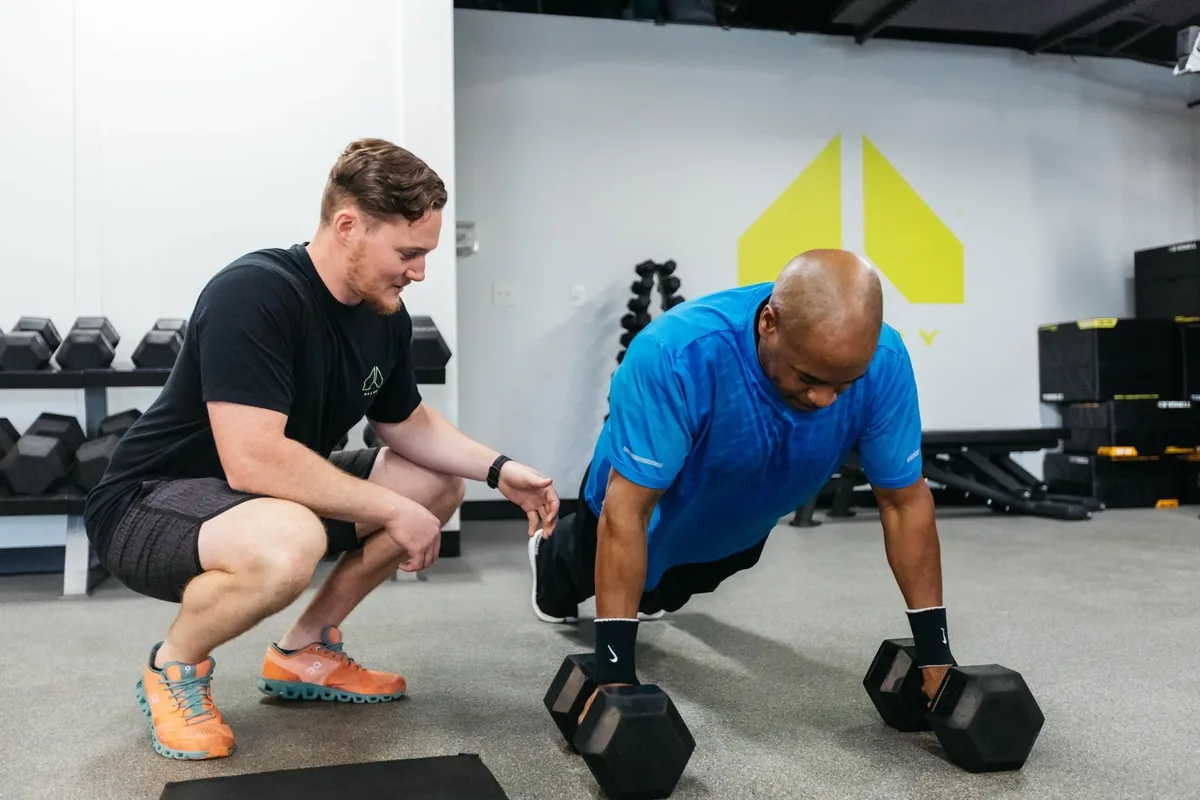
Your program should look different from the person training next to you. Ask the trainer how they decide what you do and when they change it.
Good answers sound specific. They'll mention adjusting exercises around your joints, adding load or reps on a schedule, and swapping movements when something isn't working. Weak answers sound like "we mix it up" or "every day is different." Variety for its own sake isn't a plan.
You should also be able to see your progress. Ask whether they track your weights, reps, and measurements over time, and how often they review them with you. More on what that looks like in practice: personalized exercise programming.
Why accountability is worth paying attention to
The hardest part of training is showing up for months, not any single workout. Industry data backs that up. The Health & Fitness Association's 2025 benchmarking report, covering more than 17,000 facilities in 27 countries, put average health club member retention at 66.4%. Roughly one in three members doesn't stick around a full year. Most people need more than a membership to stay consistent.
Supervision appears to help. In a randomized trial published in 2023, researchers split 36 resistance-trained adults into supervised and unsupervised groups for eight weeks. The supervised group completed 96% of sessions compared with 92% for the unsupervised group, had fewer dropouts (2 versus 7), and saw greater muscle and strength gains, including about a 4 kg advantage on squat one-rep max. Participants said supervision "held them accountable to a regimented training schedule."
Those participants were younger, experienced lifters. For adults 65 and older, a 2017 meta-analysis of 11 randomized controlled trials found supervised training produced greater gains in muscle strength and power than unsupervised training. The effect was moderate in size.
So ask any trainer: what happens when I miss a week? A good answer involves a real person noticing and following up. See how accountability sessions work.
Questions to ask, with answers you can check
Bring these to any consultation. Each answer is something you can verify.
1. "Which certification do you hold, and who issued it?" Check that it's NCCA-accredited. Ask whether they also hold a degree in exercise science or a related field. 2. "What does my first session involve?" You want to hear health history, goals, and a movement assessment before any hard training. 3. "How will you change my program over time?" Listen for progression and modification, not just variety. 4. "How do you track my progress?" Ask to see what a progress record looks like. 5. "How many people are in a session?" This tells you how much coaching attention you'll get. For a side-by-side look, read small group vs. private training.
Red flags worth walking away from
Some warning signs are about scope. Personal trainers coach exercise. They don't diagnose injuries or prescribe treatment, and the good ones refer you to a medical provider when something's beyond their lane.
Walk away if a trainer:
- Can't tell you the name of their certification
- Leans hard on selling you supplements
- Tells you what's medically wrong with your shoulder, or pushes you to train through pain
- Gives everyone the same program
- Starts you without any intake or assessment
Questions people ask
Do personal trainers need a license in Colorado? No. Colorado doesn't require a government-issued license to work as a personal trainer, and neither does any other state. That's why checking for an NCCA-accredited certification matters. It's the closest thing to a quality floor.
What's the difference between a CSCS and a regular personal trainer certification? The CSCS requires a bachelor's degree on top of passing the exam, while many personal trainer certifications require a high school diploma or GED. Both can be NCCA-accredited. The CSCS is issued by the NSCA, which is headquartered in Colorado Springs.
Is a trainer with a degree always better? Not automatically. Experience, communication, and how well they listen to you matter too. A degree-based credential does tell you the trainer has studied exercise science formally, which is a useful signal when you're comparing options.
How do I know if a trainer is right for someone over 40? Ask how they handle past injuries and how they modify exercises. A good fit will start with an assessment, explain why each exercise is in your program, and adjust as you go rather than handing you a generic routine.
Start with a coach who learns about you first
The right trainer will spend your first session getting to know your history, your goals, and how you move. That's how every new member starts here: a health history, a goals conversation, an InBody scan, a movement assessment, and an introductory workout, with a membership recommendation at the end.